What Is OAI-SearchBot?
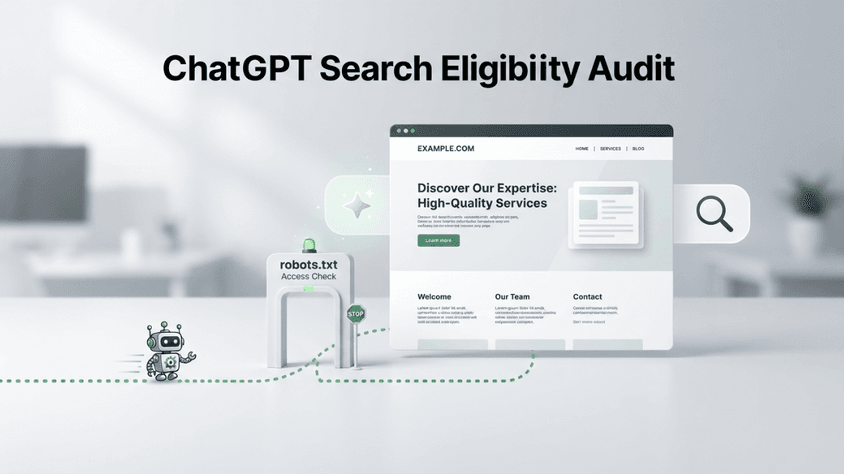
OAI-SearchBot is OpenAI’s web crawler for ChatGPT search features. Its job is to visit public web pages so OpenAI’s search systems can discover and potentially surface those pages in ChatGPT search answers. If you run a website, OAI-SearchBot matters because blocking it can prevent your content from appearing as a source in ChatGPT search, while allowing it makes the site eligible for discovery — but does not guarantee visibility or ranking. (platform.openai.com)
The important distinction is that OAI-SearchBot is not the same as GPTBot. OpenAI documents them as separate controls: OAI-SearchBot is for search, while GPTBot controls crawling of content that may be used to train OpenAI’s generative AI foundation models. (platform.openai.com)
Direct Answer
OAI-SearchBot is OpenAI’s automated search crawler. It visits websites on behalf of OpenAI’s search systems and helps make web content available for inclusion in ChatGPT search results.
Website owners can control OAI-SearchBot through robots.txt. Allowing it can make pages eligible to appear as cited sources in ChatGPT search. Blocking it opts the site or specified paths out of automatic crawling for Search. OpenAI states that search visibility and model-training controls are independent. (platform.openai.com)
Key Facts
| Question | Answer |
|---|---|
| Who operates it? | OpenAI |
| Main purpose | Crawling websites for ChatGPT search |
| robots.txt name | OAI-SearchBot |
| Does allowing it guarantee rankings? | No |
| Is it the training crawler? | No — GPTBot is the separate training-related crawler |
| Can it be blocked? | Yes, through robots.txt |
| Can legitimate requests be verified? | OpenAI publishes SearchBot IP ranges |
OpenAI also notes that a robots.txt change can take approximately 24 hours to propagate through its search systems. (platform.openai.com)
Why OAI-SearchBot Matters
Traditional SEO usually focuses heavily on search engines such as Google and Bing. AI search introduces another discovery surface: users can ask a question inside ChatGPT and receive an answer supported by cited web sources.
For a website to participate effectively in that process, OpenAI needs to be able to access its content. OpenAI's publisher documentation specifically says that sites should avoid blocking OAI-SearchBot if they want their content included in ChatGPT summaries and snippets. (help.openai.com)
That does not mean allowing the crawler automatically gives a page visibility. OpenAI states that ChatGPT search uses multiple factors to rank results and that placement is not guaranteed. Crawler access is therefore better understood as an eligibility requirement, not a ranking advantage by itself. (help.openai.com)
INTERNAL LINK: How ChatGPT Search Works
How OAI-SearchBot Works
At a simplified level, the process looks like this:
Public page → OAI-SearchBot → page discovery and processing → ChatGPT search systems → potential citation or result
When OAI-SearchBot requests a website, the site can provide crawling instructions through /robots.txt. The Robots Exclusion Protocol defines groups based on crawler user-agent names and Allow or Disallow rules that control which URL paths a compliant crawler may access. (rfc-editor.org)
OpenAI documents an OAI-SearchBot user-agent string containing:
OAI-SearchBot/1.4
The version number can change, so systems should generally identify the crawler by the OAI-SearchBot product token rather than assuming a permanent version number. OpenAI also publishes the IP ranges used by SearchBot separately. (platform.openai.com)
Once content is accessible, OpenAI's search systems may use it when deciding which sources are relevant to a user's query. Crawling and ranking should not be confused: successful crawling means OpenAI can access the page; it does not prove that the page will be selected for a particular answer.
OAI-SearchBot vs GPTBot
One of the most common mistakes is treating every OpenAI crawler as the same bot.
| Crawler | Main purpose | Primary control |
|---|---|---|
| OAI-SearchBot | ChatGPT search discovery | robots.txt |
| GPTBot | Crawling content that may be used for training OpenAI foundation models | robots.txt |
| ChatGPT-User | Page visits triggered by certain user actions in ChatGPT | Different behavior; not an automatic search crawler |
| OAI-AdsBot | Validation and relevance processing for ChatGPT ad landing pages | robots.txt and infrastructure access |
OpenAI explicitly documents OAI-SearchBot and GPTBot as independent controls. A publisher can, for example, allow OAI-SearchBot while disallowing GPTBot. This lets the site participate in ChatGPT search while indicating that its crawled content should not be used for foundation-model training. (platform.openai.com)
ChatGPT-User is different again. OpenAI describes it as being used for certain actions initiated by users rather than automatic web crawling, and says it is not the control used to determine Search eligibility. (platform.openai.com)
INTERNAL LINK: OAI-SearchBot vs GPTBot
How to Allow OAI-SearchBot
To explicitly allow OAI-SearchBot across the site:
User-agent: OAI-SearchBot
Allow: /
OpenAI uses the same pattern in its crawler guidance. (help.openai.com)
You can also control access to selected paths:
User-agent: OAI-SearchBot
Allow: /
Disallow: /private/
Disallow: /internal/
The Robots Exclusion Protocol defines how user-agent groups and path rules are matched. More specific path matches take precedence over less specific ones. (rfc-editor.org)
However, robots.txt should never be treated as a security mechanism. RFC 9309 explicitly states that robots rules are not access authorization. Sensitive information should be protected through authentication, authorization and proper server-side access controls rather than relying on crawler instructions. (rfc-editor.org)
INTERNAL LINK: robots.txt Explained
How to Block OAI-SearchBot
To block automatic SearchBot crawling across the entire site:
User-agent: OAI-SearchBot
Disallow: /
OpenAI states that sites opted out of OAI-SearchBot will not be shown as content in ChatGPT search answers, although a site may still appear as a navigational link in some circumstances. OpenAI's publisher documentation also notes cases where a URL discovered through another source may still be surfaced as a link and title. (platform.openai.com)
That distinction matters: blocking crawling and making a URL completely undiscoverable are not necessarily the same thing.
How to Verify the Crawler
Checking only the HTTP User-Agent string is useful for log analysis, but it should not be your only security signal. User-agent strings can be imitated by other clients.
OpenAI publishes official IP ranges for OAI-SearchBot in a machine-readable JSON file. The currently published list contains IPv4 network prefixes specifically associated with SearchBot. (openai.com)
For production infrastructure, a practical verification workflow is:
- Look for
OAI-SearchBotin web-server, CDN or WAF logs. - Check the request source IP.
- Compare it against OpenAI's current published SearchBot IP ranges.
- Check for
403,429, bot-challenge or rate-limit events. - Confirm that the requested URL is allowed by
robots.txt.
This is especially relevant when Cloudflare, Akamai or another bot-protection layer sits in front of the origin server. OpenAI documents that these systems can accidentally block its crawlers and recommends checking firewall, CDN and bot-mitigation rules when crawling fails. (help.openai.com)
Common Misconceptions
“Allowing OAI-SearchBot allows OpenAI to train on my site.”
Not by itself. OpenAI provides GPTBot as the separate robots.txt control for content that may be used to train its generative AI foundation models. (platform.openai.com)
“If SearchBot can crawl me, ChatGPT will rank my site.”
No. Crawling provides access and eligibility. OpenAI explicitly says placement in search results is not guaranteed. (help.openai.com)
“robots.txt protects private pages.”
No. It communicates crawler preferences; it is not an authorization system. Private resources still require real access controls. (rfc-editor.org)
“All ChatGPT traffic comes from OAI-SearchBot.”
No. OpenAI documents multiple agents, including OAI-SearchBot, GPTBot, ChatGPT-User and OAI-AdsBot, with different purposes. (platform.openai.com)
SeoNest Recommendation
If your goal is to make public articles, products, services or documentation discoverable through ChatGPT search, allow OAI-SearchBot to access those pages.
Treat it similarly to other legitimate search crawlers: ensure important content is publicly reachable, return normal successful HTTP responses, avoid accidentally blocking the crawler at the CDN or WAF layer, and verify traffic against OpenAI's published IP ranges when necessary.
Decide on GPTBot separately. Search visibility and AI-model training are not the same technical decision, and OpenAI provides separate crawler controls specifically so publishers can manage them independently. (platform.openai.com)
INTERNAL LINK: AI Crawler Access Guide
FAQ
Is OAI-SearchBot an AI crawler?
Yes. It is an automated web crawler operated by OpenAI specifically for its search functionality. (platform.openai.com)
Does OAI-SearchBot affect SEO?
It can affect whether your content is eligible to be discovered and surfaced through ChatGPT search. There is not enough public evidence to treat crawler access itself as a ranking signal. OpenAI only states that access is needed for eligibility and that multiple factors determine search ranking. (help.openai.com)
Should I allow OAI-SearchBot?
If you want public content to be eligible for inclusion in ChatGPT search results, allowing it is the appropriate configuration. If you intentionally do not want SearchBot crawling particular content, you can restrict those paths through robots.txt.
Can I allow SearchBot but block GPTBot?
Yes. OpenAI explicitly supports that configuration because the two controls are independent. (platform.openai.com)
How long do robots.txt changes take?
OpenAI currently documents that Search-related systems may take approximately 24 hours to adjust after a site's robots.txt configuration changes. (platform.openai.com)
Final Takeaway
OAI-SearchBot is the crawler that connects public websites with OpenAI's search ecosystem. Allowing it does not guarantee ChatGPT visibility, but blocking it can remove your content from normal ChatGPT search answers.
The most important technical distinction is simple: OAI-SearchBot controls search access; GPTBot controls the separate training-related use case. Website owners should configure each according to their publishing goals rather than treating all AI crawlers as one system.
Sources
- OpenAI — Overview of OpenAI Crawlers. Current developer documentation accessed September 18, 2026. Documents OAI-SearchBot, GPTBot, ChatGPT-User, OAI-AdsBot, user-agent strings, robots.txt behavior and SearchBot IP publication. (platform.openai.com)
- OpenAI — Publishers and Developers FAQ. Current documentation accessed September 18, 2026. Covers OAI-SearchBot access, ChatGPT search discovery, snippets, citations and navigational links. (help.openai.com)
- OpenAI — Searching the Web with ChatGPT. Current documentation accessed September 18, 2026. Covers website eligibility and the fact that search placement is not guaranteed. (help.openai.com)
- OpenAI — OAI-SearchBot Published IP Ranges. Machine-readable
searchbot.json, current version accessed September 18, 2026. (openai.com) - IETF — RFC 9309: Robots Exclusion Protocol. September 2022. Defines
robots.txt, user-agent groups,AllowandDisallowmatching and clarifies that robots rules are not authorization controls. (rfc-editor.org)