How Google Says Websites Can Succeed in Generative AI Search
Generative AI has changed how Google presents information, but Google’s advice to website owners is less radical than many SEO discussions suggest. According to Google Search Central, succeeding in AI Overviews and AI Mode does not require a separate optimization system, special AI markup, or a new kind of website.
Google’s current position is that generative AI Search is still built on the foundations of Google Search. Strong technical SEO, crawlable and indexable pages, useful content, and genuine original value remain the priorities. In 2026, Google went further by explicitly addressing several popular GEO and AEO tactics—and saying many of them are unnecessary.
The Direct Answer
Google says websites should approach generative AI Search by continuing to follow solid SEO practices while creating unique, valuable, non-commodity content for people.
AI Overviews and AI Mode use Google’s Search index and core ranking and quality systems to find supporting information. A page therefore needs to be discoverable, crawlable, indexed, and eligible to appear in Google Search before it can become a supporting source in these AI experiences.
There is no special requirement to create an “AI-optimized” version of the site.
SEO Still Matters
Google explicitly says SEO remains relevant to generative AI Search.
One reason is retrieval-augmented generation (RAG). In simplified terms, Google can retrieve relevant and up-to-date pages from its Search index and use information from those pages to ground an AI-generated response. The response can then include clickable links to supporting websites.
AI Mode and AI Overviews may also use query fan-out. Instead of processing only the exact query a person entered, the system can generate several related searches across subtopics.
For example, a question such as:
“How do I fix a lawn full of weeds?”
could lead the system to explore related questions about herbicides, chemical-free removal methods, and preventing weeds from returning.
This has an important implication: pages do not need to repeat every possible long-tail query word-for-word. Google says its systems can understand meaning and relevance even when a page does not exactly match the wording of the search.
INTERNAL LINK: Google AI Mode: How It Works
Create Non-Commodity Content
Perhaps the strongest theme in Google’s current guidance is non-commodity content.
Commodity content is information that could come from almost anywhere: another article, a generic summary, or increasingly, a generative AI model.
Google gives examples that contrast common advice with content based on genuine experience. The point is not that standard informational articles cannot perform. It is that distinctive knowledge gives Google—and readers—a reason to value one source over dozens of similar pages.
Useful differentiation can come from:
- first-hand experience;
- original research or measurements;
- expert analysis;
- unique data;
- real examples and case studies;
- observations that are difficult to reproduce by simply summarizing existing pages.
This aligns with Google’s broader people-first content guidance, which asks whether content contains original information, research or analysis and whether it demonstrates first-hand expertise and meaningful depth.
The practical question is therefore not simply, “Can AI understand this page?”
A better question is, “Does this page contribute something worth retrieving?”
INTERNAL LINK: Non-Commodity Content: What It Means for AI Search
Keep Technical SEO Clear
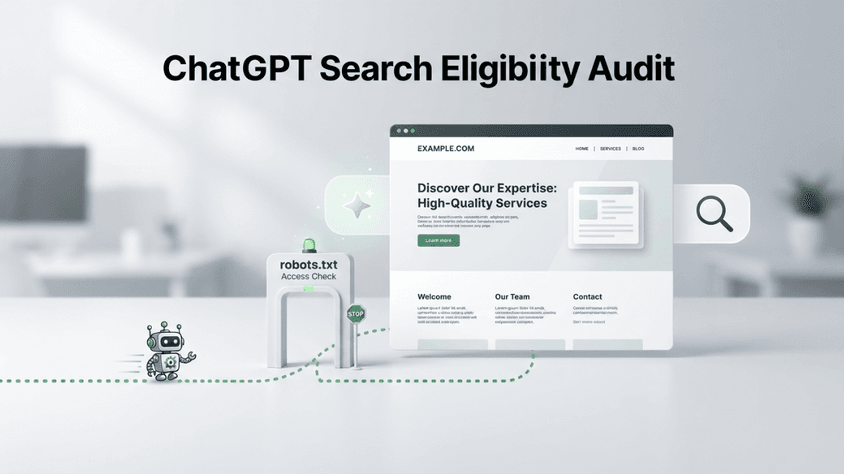
Content quality cannot help if Google cannot properly access the page.
Google says a page must meet Search’s technical requirements, be indexed, and be eligible to appear with a snippet to qualify for generative AI Search visibility. Meeting those conditions does not guarantee selection, indexing, or visibility.
The familiar technical fundamentals still apply:
- allow appropriate crawling;
- avoid accidentally blocking Googlebot through
robots.txt, a CDN, or hosting configuration; - make important content accessible to Google;
- use sensible internal linking;
- follow JavaScript SEO practices when content depends on JavaScript;
- provide a good experience across devices;
- reduce unnecessary duplicate URLs;
- make important information available as text;
- use relevant high-quality images and video where useful.
Structured data still has value for supported Search features, but Google says there is no special schema.org markup required for generative AI Search. Structured data should also match what users can actually see on the page.
For ecommerce and local businesses, Google additionally points website owners toward accurate Merchant Center feeds and Google Business Profile information where relevant.
GEO Hacks You Can Ignore
Google’s 2026 documentation directly addresses several common AI-search recommendations.
For Google Search, you do not need:
- an
llms.txtfile; - special AI-specific machine-readable markup;
- special Markdown copies of pages;
- tiny content “chunks” created specifically for AI;
- rewritten pages designed only for AI systems;
- every imaginable long-tail query variation;
- artificial mentions across third-party websites;
- special generative-AI schema markup.
Google says llms.txt, for example, neither helps nor harms Google Search visibility because Google Search does not use it. Other AI systems may choose to support such files, so this conclusion is specific to Google Search.
This distinction matters. Something marketed as a general “GEO best practice” is not automatically a Google requirement.
Google acknowledges the terms AEO and GEO, but from Google Search’s perspective, optimization for its generative AI experiences remains part of SEO.
INTERNAL LINK: Does GEO Really Exist? What Google Actually Says
Measure AI Visibility
Measurement has also changed.
Google introduced dedicated Search Console generative AI performance reports in June 2026 and states that, as of August 31, 2026, these insights had rolled out to all websites worldwide.
The reports can show:
- impressions in generative AI features;
- pages that appeared;
- visibility by country;
- device data for Search;
- performance over time.
This gives site owners a better way to evaluate actual AI Search visibility instead of depending entirely on manual searches or third-party visibility estimates. Google also warns that external tools do not have access to its internal ranking or AI systems.
Conversions still matter too. An AI visibility impression has limited business value if visitors do not subscribe, purchase, contact the company, or otherwise complete the intended goal.
Build an Audience Too
A newer development is Google’s Preferred Sources feature.
Users can select publications they want to see more prominently. When a user chooses a website as a preferred source, Google says that site can receive a preferred badge in AI Mode and AI Overviews where those features are available.
That does not replace SEO. It highlights another important principle: building an audience that deliberately values your website can become increasingly meaningful as Search becomes more personalized.
SeoNest Recommendation
Treat Google’s generative AI Search as an expansion of Search, not as permission to abandon SEO and chase a new collection of hacks.
First make the website technically reliable and indexable. Then concentrate editorial effort on information competitors and generic AI summaries cannot easily reproduce: expertise, evidence, experience, useful datasets, clear explanations, strong visuals, and genuine analysis.
Use Google’s new Search Console reports to measure whether those pages actually appear in generative AI experiences.
The strongest AI Search strategy is therefore surprisingly familiar:
make information easy for Google to retrieve, but valuable enough that it is worth retrieving.
FAQ
Does Google require GEO?
No. Google recognizes GEO as a term used by the industry, but says optimizing for generative AI features in Google Search is still SEO from its perspective.
Do I need llms.txt?
Not for Google Search. Google states that Search ignores llms.txt; creating one neither improves nor damages Google Search visibility. Other services may have different requirements.
Is special AI schema required?
No. Google says there is no special schema.org structured data required for generative AI Search. Existing structured data remains useful for the Search features that support it.
Can good SEO guarantee AI citations?
No. Meeting Google’s technical requirements and best practices makes a page eligible, but Google does not guarantee crawling, indexing, ranking, or inclusion in an AI-generated response.
Final Takeaway
Google’s message is clearer than much of the discussion around GEO: generative AI Search changes how information can be retrieved, synthesized, and presented, but it does not erase the fundamentals of Search.
Technical accessibility gets content into the system. Strong SEO helps Google understand and retrieve it. Unique, people-first, non-commodity information gives the page a reason to stand out.
For Google Search, that is currently a more defensible strategy than attempting to reverse-engineer an undocumented “AI citation algorithm.”
Sources
- Google Search Central — “Optimizing your website for generative AI features on Google Search.” Last updated July 10, 2026. https://developers.google.com/search/docs/fundamentals/ai-optimization-guide
- Google Search Central — “AI Features and Your Website.” Last updated December 10, 2025. https://developers.google.com/search/docs/appearance/ai-features?utm_source=chatgpt.com
- Google Search Central — “Creating helpful, reliable, people-first content.”https://developers.google.com/search/docs/fundamentals/creating-helpful-content?utm_source=chatgpt.com
- Google Search Central — “Introducing Search Generative AI performance reports in Search Console.” June 3, 2026; rollout note updated August 31, 2026. https://developers.google.com/search/blog/2026/06/gen-ai-performance-reports
- Google Search Central — “Help your readers find your site through preferred sources in Google Search.” Last updated August 20, 2026. https://developers.google.com/search/docs/appearance/preferred-sources?authuser=451499271
- Google Search Central — “Top ways to ensure your content performs well in Google's AI experiences on Search.” May 21, 2025. https://developers.google.com/search/blog/2025/05/succeeding-in-ai-search?utm_source=chatgpt.com