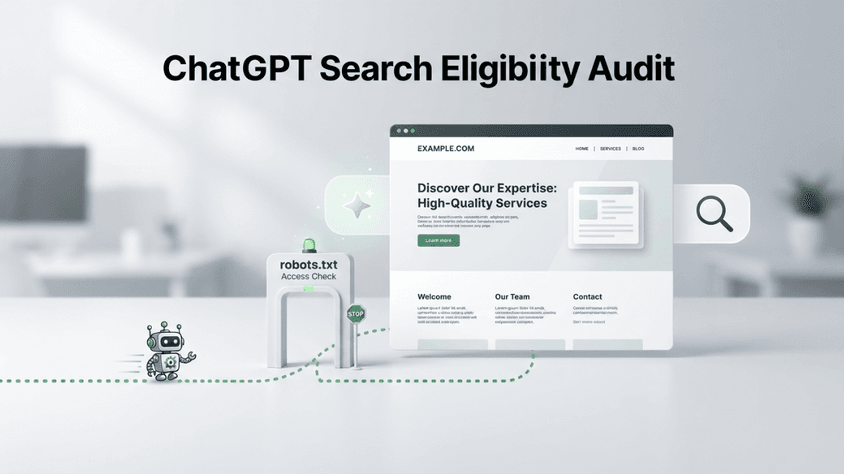
What Is ChatGPT Search?
ChatGPT can answer from what a model has learned, but some questions depend on information that changes: today’s news, current product details, local businesses, recent research, prices, schedules, or newly published web pages. ChatGPT Search is designed for that gap.
Instead of forcing the user to leave the conversation, open a search engine, inspect several pages, and bring the information back, ChatGPT can search the web inside the conversation, synthesize what it finds, and provide links to supporting sources. OpenAI introduced ChatGPT Search on October 31, 2024, after testing a temporary SearchGPT prototype earlier that year. (openai.com)
Direct Answer
ChatGPT Search is ChatGPT’s web-search capability. It lets ChatGPT retrieve current information from the web, combine relevant findings into a conversational answer, and provide citations or source links that users can inspect.
ChatGPT may decide automatically that a question would benefit from web information, or the user can explicitly select Search. As of September 2026, OpenAI says web search is available across its Free, Go, Plus, Pro, Business, Enterprise, and Edu plans, as well as to people who are not signed in. (help.openai.com)
Key Facts
| Question | Answer |
|---|---|
| Does it search the live web? | It can retrieve current web information when search is used. |
| Does every ChatGPT answer use search? | No. ChatGPT may search automatically when useful, or the user can select Search. |
| Does it provide sources? | Search answers can include citations and a Sources panel. |
| Can it rewrite your query? | Yes. OpenAI documents that one prompt may become one or more targeted search queries. |
| Can websites control access? | Yes. OAI-SearchBot can be controlled through robots.txt. |
| Is search crawling the same as AI training? | No. OpenAI provides separate controls for OAI-SearchBot and GPTBot. |
How ChatGPT Search Works
The simplest mental model is:
question → search queries → web sources → synthesis → cited answer
The real process can be more flexible.
When web information would improve an answer, ChatGPT can initiate a search. OpenAI says ChatGPT Search may rewrite the user’s original request into one or more more targeted queries for search providers. After examining initial results, it can issue additional, more specific searches. (help.openai.com)
For example, a person does not necessarily need to formulate a traditional keyword query such as:
best technical seo tools enterprise 2026
They could instead ask:
Which technical SEO tools are best for a 500,000-page ecommerce site, and what are the main trade-offs?
Search can gather relevant web information while ChatGPT handles the conversational interpretation and synthesis.
OpenAI also says approximate location derived from an IP address can help with local searches. If device-location sharing is enabled, more precise location can be used. Relevant Memory information may also influence how a prompt is rewritten into a search query. OpenAI states that the IP address itself and ChatGPT account information are not sent to third-party search providers merely to run the search. (help.openai.com)
Search vs Traditional Search
The difference is not simply that one interface has AI.
| Traditional search | ChatGPT Search |
|---|---|
| Usually returns a ranked results page | Often produces a synthesized answer |
| User interprets several results manually | ChatGPT can combine information from several sources |
| New query usually starts another search | Follow-up questions can remain conversational |
| Links are the primary output | Answer and supporting links can appear together |
| User performs most of the synthesis | The model performs part of the synthesis |
This changes the user journey from roughly:
search → inspect results → open pages → compare information → form answer
to:
ask → retrieve sources → receive synthesis → verify or continue
That can reduce search effort, but it also introduces an important responsibility: the synthesized answer itself must be checked when accuracy matters.
INTERNAL LINK: AI Search vs Traditional Search: How the User Journey Changes
Sources Still Matter
ChatGPT Search does not make source quality irrelevant. It makes source verification more important.
Search responses can contain inline citations, and users can open the cited pages or inspect additional links through the Sources interface. OpenAI explicitly warns that search results and citations can still be incomplete, outdated, or incorrect and recommends checking authoritative sources for important information. (help.openai.com)
A citation therefore means “this source was presented in support of the answer,” not “this statement is automatically correct.”
For medical, financial, legal, scientific, security, or other high-impact decisions, the sensible workflow remains:
answer → inspect evidence → confirm the original source → decide
What It Means for Websites
For publishers and SEO teams, one distinction is especially important: OAI-SearchBot and GPTBot have different purposes.
OpenAI documents OAI-SearchBot as the crawler used to surface websites in ChatGPT search features. GPTBot, by contrast, is associated with crawling content that may be used to improve OpenAI’s generative AI foundation models. These controls are independent, so a publisher can allow OAI-SearchBot for search visibility while blocking GPTBot for training-related crawling. (platform.openai.com)
A basic configuration could therefore look like:
User-agent: OAI-SearchBot
Allow: /

User-agent: GPTBot
Disallow: /
That does not guarantee visibility or a particular position. OpenAI says ChatGPT Search ranking uses multiple factors intended to surface relevant, reliable information and that top placement cannot be guaranteed. (help.openai.com)
OpenAI also says publishers permitting OAI-SearchBot can identify referral visits because ChatGPT adds utm_source=chatgpt.com to referral URLs. (help.openai.com)
INTERNAL LINK: How AI Crawlers Access Your Website
SearchGPT vs ChatGPT Search
SearchGPT was not a separate permanent search engine.
OpenAI launched SearchGPT on July 25, 2024 as a temporary prototype for testing AI search features with a limited group of users and publishers. OpenAI explicitly said it planned to integrate the best parts of that experience into ChatGPT. ChatGPT Search followed on October 31, 2024. (openai.com)
So today, when discussing OpenAI’s consumer web-search experience, ChatGPT Search is the more relevant term.
What We Do Not Know
Not every part of ChatGPT Search is publicly documented.
OpenAI explains important pieces such as query rewriting, search-provider use, citations, crawler controls, and location handling. It does not publicly document a complete ranking algorithm or every weighting signal used to decide which pages become sources.
It would therefore be inaccurate to claim that a specific schema type, content format, word count, backlink threshold, or “GEO tactic” guarantees a citation in ChatGPT.
Available evidence supports improving discoverability and technical access. It does not support a formula for guaranteed ChatGPT Search rankings.
INTERNAL LINK: Does GEO Really Exist? What Google Actually Says
SeoNest Recommendation
Treat ChatGPT Search as both a search system and an answer interface.
For users, take advantage of natural-language questions and follow-ups, but inspect important citations instead of assuming the synthesized answer is authoritative.
For publishers, start with fundamentals: make valuable public content technically accessible to OAI-SearchBot, avoid accidentally blocking its published IP ranges, publish information that genuinely answers user questions, make important claims easy to verify, and measure actual ChatGPT referral traffic.
Do not replace sound SEO and publishing practices with unverified “AI ranking hacks.” OpenAI has not published enough information to justify them.
FAQ
Does ChatGPT always search the web?
No. ChatGPT can search automatically when a question would benefit from current web information, and users can also choose Search manually. (help.openai.com)
Is ChatGPT Search a search engine?
Functionally, it provides a web-search experience, but its interface differs from a conventional search-results page. It combines retrieval with a language model that synthesizes an answer and can continue the discussion conversationally.
Does ChatGPT Search use only OpenAI’s crawler?
No. OpenAI says ChatGPT Search can use third-party search providers as well as other available web information. OAI-SearchBot is specifically used to help surface websites in ChatGPT search features. (openai.com)
Does allowing OAI-SearchBot allow AI training?
Not by itself. OpenAI documents OAI-SearchBot and GPTBot as separate controls. A site can allow search crawling while disallowing GPTBot. (platform.openai.com)
Can ChatGPT Search give incorrect information?
Yes. OpenAI warns that search results, citations, and ChatGPT answers can contain errors. Important claims should still be checked against reliable original sources. (help.openai.com)
Final Takeaway
ChatGPT Search adds live web retrieval to a conversational AI interface. Its important shift is not simply that ChatGPT can find websites; it can search, reformulate queries, combine information, answer directly, cite sources, and continue reasoning about the result in the same conversation.
That makes web search faster for many questions, but it does not remove the need for reliable sources. For users, verification still matters. For publishers, crawlability, useful content, clear evidence, and genuine relevance matter more than attempts to reverse-engineer an undocumented ranking formula.
Sources
- OpenAI Help Center — “Searching the web with ChatGPT.” Current documentation, accessed September 11, 2026. OpenAI Help Center: Searching the web with ChatGPT (help.openai.com)
- OpenAI — “Introducing ChatGPT search.” October 31, 2024; page includes subsequent availability updates. OpenAI: Introducing ChatGPT search (openai.com)
- OpenAI — “SearchGPT Prototype.” July 25, 2024. OpenAI: SearchGPT Prototype (openai.com)
- OpenAI Developers — “Overview of OpenAI Crawlers.” Current documentation, accessed September 11, 2026. OpenAI Developers: Overview of OpenAI Crawlers (platform.openai.com)
- OpenAI Help Center — “Publishers and Developers – FAQ.” Current publisher guidance, accessed September 11, 2026. OpenAI: Publishers and Developers FAQ (help.openai.com)
- OpenAI Help Center — “Does ChatGPT tell the truth?” Current guidance on factual reliability and web search, accessed September 11, 2026. OpenAI: Does ChatGPT tell the truth? (help.openai.com)