What AI Search Optimization Can and Cannot Control
AI search optimization creates an easy misconception: if you format content correctly, add the right schema, or allow the right crawler, an AI system will choose your page and cite it. That is not how modern search systems work.
Website owners can control what they publish, what crawlers may access, and some ways content may be reused or previewed. They can also improve the signals that help search systems understand and retrieve a page. But they cannot command an AI system to select a page, cite it, rank it, or produce a particular answer.
Understanding that boundary makes AI search optimization much more practical.
Direct Answer
AI search optimization can directly control your website and the permissions you expose to external systems. It can influence discovery, indexing, relevance, interpretation, and eligibility.
It cannot directly control retrieval decisions, ranking, query expansion, source selection, citation placement, generated wording, or whether an AI answer appears at all.
Google explicitly says there are no additional technical requirements or special schema needed for inclusion in AI Overviews or AI Mode beyond the relevant Search requirements. Meeting those requirements makes a page eligible; it does not guarantee that Google will crawl, index, retrieve, or show it. (developers.google.com)
Three Levels of Control
| Level | What it means | Examples |
|---|---|---|
| Control | You can directly configure it | Page content, robots.txt, noindex, canonical signals, structured data |
| Influence | You can improve the probability of an outcome | Relevance, crawlability, entity clarity, usefulness, source eligibility |
| Cannot control | The search or AI system decides | Ranking, retrieval, citations, generated answers, query fan-out |
The mistake is treating an influence as if it were a control.
What You Can Control
You control the information actually available on your website: text, headings, images, links, structured data, HTTP responses, page architecture, and whether important information is available in crawlable form.
You also have real crawler and indexing controls.
For Google Search, robots.txt can restrict Googlebot from requesting particular URLs. However, blocking crawling is not the same as guaranteeing that a URL disappears from Search. Google documents that a blocked URL may still be indexed without its content if Google discovers the URL elsewhere. (developers.google.com)
For stronger page-level control, Google supports directives including noindex, nosnippet, max-snippet, and data-nosnippet. In particular, Google documents that nosnippet prevents page content from being used as a direct input for AI Overviews and AI Mode, while max-snippet limits the amount that may be used as a direct input. (developers.google.com)
These are genuine controls because the publisher is explicitly communicating what the search system is permitted to crawl, index, or expose.
What You Can Influence
Most optimization work sits here.
You can make a page technically accessible, clearly structured, internally linked, fast enough to use comfortably, semantically understandable, and genuinely useful. You can publish original evidence, expert explanations, product data, images, videos, comparisons, and other information that gives the page a reason to be retrieved.
Google's 2026 guidance specifically emphasizes foundational SEO and useful, non-commodity content rather than special "GEO" mechanisms. It also says techniques such as unnecessary AI-specific text files or artificial optimization tricks are not required for its generative Search features. (developers.google.com)
Structured data belongs in this influence category too. It can help Google understand entities and make a page eligible for particular search features, but correct markup does not guarantee that a feature will appear. (developers.google.com)
Even rel="canonical" is primarily a signal of preference rather than an absolute command. Google may select another canonical URL when its systems consider another version more representative. (developers.google.com)
That distinction matters: good optimization improves the inputs available to retrieval systems; it does not dictate their final decision.
What You Cannot Control
You cannot force an AI search system to retrieve your URL for a specific prompt.
You also cannot determine exactly which passage will be extracted, which competing sources will be consulted, where your citation will appear, or how the final answer will phrase information from multiple sources.
Google says AI Overviews and AI Mode may use query fan-out, where the system generates multiple related searches across subtopics and data sources. The models and techniques used can also vary, meaning different searches may retrieve different supporting pages even when the original query appears similar. (developers.google.com)
Traditional ranking has the same fundamental limitation. Google describes its ranking systems as evaluating many factors and signals across enormous numbers of pages. Optimizing one factor does not create a guaranteed position. (developers.google.com)
Promises such as "implement this schema and ChatGPT will cite you" or "follow these GEO rules and rank in AI Overviews" therefore go beyond what public evidence supports.
Search Is Not Training
Another common mistake is treating AI search access and AI model training as the same permission.
They may be separate.
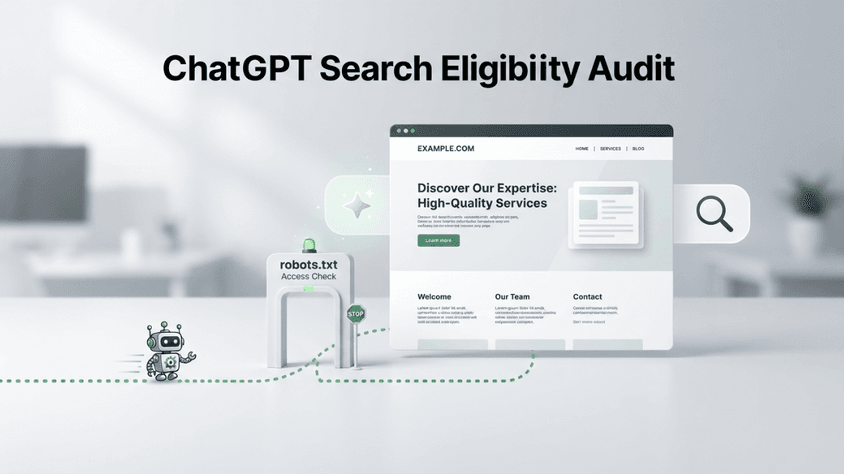
OpenAI currently documents OAI-SearchBot as the crawler publishers should allow if they want site content to be available for ChatGPT search summaries and snippets. OpenAI separately uses GPTBot as a control for publishers who want pages excluded from potential model training. (help.openai.com)
Google has a similar separation. Googlebot controls crawling for Google Search, including Search features, while Google-Extended lets publishers manage certain uses involving future Gemini model training and grounding in other Gemini products. Google explicitly states that Google-Extended does not affect inclusion or ranking in Google Search. (developers.google.com)
So blocking an AI-training crawler does not automatically mean opting out of every AI-powered search experience, and allowing search crawling does not necessarily grant every possible training use.
INTERNAL LINK: AI Crawlers Explained: Googlebot, OAI-SearchBot, GPTBot and Google-Extended
Measure Instead of Guess
Because source selection cannot be controlled, measurement should focus on outcomes rather than assumed "AI ranking factors."
Google introduced dedicated Generative AI performance reporting in Search Console in 2026. According to Google, these reports were rolled out to websites worldwide by August 31, 2026, providing visibility into impressions from generative AI experiences such as AI Overviews and AI Mode. (developers.google.com)
OpenAI also documents that ChatGPT search referral URLs include utm_source=chatgpt.com, allowing publishers to identify referral traffic in analytics tools. (help.openai.com)
Useful measurements therefore include visibility, referred visits, landing pages, engagement, conversions, and which subjects repeatedly attract AI-search traffic.
These observations still show correlation, not a complete explanation of an AI system's internal retrieval logic.
SeoNest Recommendation
Treat AI search optimization as engineering the best available inputs, not controlling the output.
First, control what is genuinely yours: crawler permissions, indexing rules, previews, content quality, technical accessibility, structured data, canonical signals, and site architecture.
Then improve the factors you can influence: original information, entity clarity, topical depth, internal relationships, evidence, useful multimedia, and information that directly answers real questions.
Finally, accept the external layer as probabilistic. Search providers control retrieval, ranking, model behavior, citations, interface design, and answer generation.
This approach is less exciting than a "GEO hack," but it matches how the systems are actually documented.
FAQ
Can I Guarantee an AI Citation?
No. You can make content accessible and highly relevant, but public documentation from major providers does not offer a mechanism that guarantees citation for a query.
Does Schema Guarantee AI Visibility?
No. Structured data can improve machine understanding and eligibility for supported features, but Google explicitly says valid structured data does not guarantee a particular search appearance. (developers.google.com)
Should I Block AI Crawlers?
That depends on your objective. Search crawling, training, agent access, and other uses may have different crawler controls. Decide which uses you want before creating a blanket block.
Is AI Optimization Different From SEO?
The terminology varies by industry. For Google Search specifically, Google states that its generative AI experiences remain rooted in core Search systems and that existing SEO fundamentals continue to apply. (developers.google.com)
Final Takeaway
AI search optimization gives publishers meaningful control over access, content, and permissions, and meaningful influence over discoverability and relevance.
It doesn't give them control over the final decision made by a search or generative system.
The useful question is therefore not, "How do we make the AI cite us?"
It is: "Have we given retrieval systems the strongest accurate, accessible, distinctive, and permission-compatible source they could reasonably choose?"
Sources
- Google Search Central — Optimizing your website for generative AI features on Google Search, 2026. Google documentation (developers.google.com)
- Google Search Central — AI Features and Your Website, updated December 10, 2025. Google documentation (developers.google.com)
- Google Search Central — Robots meta tag, data-nosnippet, and X-Robots-Tag specifications, updated March 24, 2026. Google documentation (developers.google.com)
- Google Crawling Infrastructure — Google's common crawlers, updated July 14, 2026. Google crawler documentation (developers.google.com)
- Google Search Central — General Structured Data Guidelines. Structured data guidelines (developers.google.com)
- Google Search Central — How to Specify a Canonical with rel="canonical" and Other Methods, 2026. Canonicalization documentation (developers.google.com)
- OpenAI Help Center — Publishers and Developers — FAQ, updated August 2026. OpenAI publisher documentation (help.openai.com)
- Google Search Central — Introducing Search Generative AI performance reports in Search Console, June 3, 2026; worldwide rollout noted as complete August 31, 2026. Google Search Central announcement (developers.google.com)